• Machine Image

    If you are reading this blog, you are either a parent, caregiver, teacher or a student yourself. You already understand that the world is rapidly changing, and it is only prudent to change along with it. We have covered this premise in our last two blogs which you can read here (Are Todays Education Systems Ready for Tomorrow?, Tomorrow that Starts Today). In this blog, I will take the premise forward and talk about the inevitable workplace evolution. Right from the first Industrial revolution, workplaces have been constantly evolving. With the onset of the Fourth Industrial Revolution, by the year 2030, workplaces are going to completely transform. What will the workplace of 2030 look like? What will be the skills (both technical and life skills) that will be needed for such a workplace?No one can predict the future with complete accuracy. We can only attempt to foresee what lies ahead using current trends and views of other experts in the industry. Consolidating these inputs, I have created a snapshot of workplaces of tomorrow around five broad categories – 

    1. The Way We Work – how will work happen

    “Uber, the world’s largest taxi company, owns no vehicles. Facebook, the world’s most popular media owner, creates no content. Alibaba, the most valuable retailer, has no inventory. And Airbnb, the world’s largest accommodation provider, owns no real estate” – Tom Goodwin

    1. Employment models introduced in the first industrial revolution are dying. Work is no longer constrained in 9-5 jobs or constrained behind one desk or one machine. Flexible working hours, work from home, freelancers, work exchange programs are all changing the way people work. With a growing clan of digital nomads, people are balancing work and life constantly in a literal sense. By 2030, the boundaries between work and life will almost blur giving way to seamless work-life routines.
    2. Businesses/individuals are pooling in resources to create solutions for global communities. For example –Android, Wikipedia, etc. Moving into the future, collaboration will be even more valued than competition. By 2030, collaboration will be a mainstream phenomenon.

    2. The Work we do – what skills will be in demand

    1. Technology will take over manual jobs at an unprecedent rate. These jobs will not only include low wage or blue-collar jobs or jobs which need low education but also professional jobs like radiologists, accountants, financial analysts and lawyers.
    2. Skills required in the market will be changing so rapidly that the most important skill in the coming years will be the speed at which one can learn something new and adapt to the changing ecosystem. Those who are not able to continuously learn and upgrade will find themselves left out.

    3. How we learn – methods and ways of learning

    We are currently preparing students for jobs that don’t yet exist using technologies that haven’t been invented in order to solve problems we don’t even know are problems yet – Karl Fisch, 2008

    1. Focus of learning will not be to memorize facts and figures or perform calculations faster than a computer. Focus of learning will be to get a macro view of the world, connect the dots and solve real world problems
    2. Knowledge will become more accessible at lesser or no cost
    3. Be it in the form of online information and courses or in-person meet ups, workshops, knowledge transfer will happen seamlessly. The only thing stopping you from learning something new will be “you” yourself.
    4. People will be constantly learning, upskilling/reskilling themselves to stay in tune with the demand of skills
    5. Regular schooling or college education will no longer be a norm with a large number of people moving to homeschooling/Unschooling. Degrees will wither in importance as the emphasis of education will shift from institutional process to educational outcomes.

    4. How we earn – ways to earn money

    1. In the present-day world, jobs are the mechanism with which individuals earn money and sustain the economy. Going into the future, this might not be the case. With the advancement of technology, machines are likely to take over the jobs as well as the responsibility of running the economy leaving people free to do what they really want to do. Countries are already experimenting with Basic Income for its citizens to ensure that people have enough money to survive in such circumstances. By the year 2030, the concept of basic income will likely become common practice. In addition to basic income, incentives will be given to people who are contributing to the economy/nation/planet in some way. Basic income will allow people time to pursue passion without worrying about making ends meet. In such circumstances, people will come forward to help each other and collaborate in place of competing.
    2. Barter system will find way again in modern trade where services will be exchanged in return for services without any monetary transaction
    3. Dollars will follow the students more than the educators. It’s quite possible that federal and state aid that currently supports institutions of higher education will be transferred directly to students allowing them freedom to follow their passion, experiment and innovate in place of funding institutions and universities.

    5. How we spend – where will consumers spend money

    1. Consumerism and materialism will slowly give way to minimalism, slow consumption and simple life. Sharing homes or cars will be the norm in place of owing them. The biggest spending will happen in areas where people find meaning for life, allowing them to connect with their inner self.
    2. Conscious living will be deeply ingrained. Bigger corporations will not go away but will be continuously challenged by smaller, creative businesses with right values.

    Summary

    Most people frown upon the Fourth Industrial Revolution holding it responsible for capitalism, breakdown of social value systems and an economy driven by the selfie culture. However, as the revolution sets in deeper and continues to transform lives, materialism will give way to minimalism and selfies supporting social causes will become a trend. Passion and innovation coupled with sense of social responsibility will be valued much more than degree-focused education. Learning will be an unending journey and hence the boundaries between school, college and professional life will disappear. The future world holds immense promise for our children. In the next blog, I will talk about the life skills that our children will need to flourish in this future world. Stay tuned and share if you believe in this future.

  • Education System

    Ever Changing Employment Landscape

    Times are changing fast. We discussed the nature of change in our previous blog – Tomorrow that starts Today. We have deduced that machines would take over more than 30% of human jobs in as soon as 5-10 years. This shift towards automation does not mean that our children will lose all jobs to machines. This only means that our children will face different jobs and business opportunities than the working class of today. This change in skills is not a new phenomenon. It is just that the speed of this phenomenon has accelerated rapidly over the last two decades. What started as an internet revolution has now transformed into a full scale automation revolution. As of today, the demand for talent in AI, digital, and machine learning is way more than the supply of these skills which has pushed salaries higher in these areas. There is a gap in the supply of these skills because we did not foresee the demand for these skills ahead of time. The present-day education systems are simply not forward looking, yet.

    Archaic Education System

    While the employment landscape is changing each day, schools on the other hand are institutions that were formed in the 19th century, employ teachers from the 20th century and cover a curriculum that was created at least 50 years ago. It is, therefore, no surprise that there is a big gap in what is taught in school vs what is needed in real life. While number of Education Institutions have risen, on an average by more than 100% across all streams of education, unemployment rates are the highest they have ever been in the last 20 years especially among the educated youth in India. The gap between skills needed vs skills taught is widening because schools are unable to change at the speed of change that the world is undergoing. This challenge is not only present in Asia but also across most developed countries in Americas, Europe and even Australia. Very few countries like Finland, Singapore and South Korea have managed to create education systems which create children which are future ready.

    What needs to change

    So, what are the above countries doing differently? Some of the factors contributing for successful education systems are late school starting age, zero homework, extremely well qualified teachers and a deep-rooted focus on collaboration than competition. In addition to what is already being done in these new age school, Educators of today need to:

    • get rid of focus on rote learning
    • give way for practical, hands on learning and related evaluation
    • create platforms such that the genius within each child can blossom
    • not only teach “what is”, but also “what could be”

    The good news is that Governments across the world, including India, are working on revising their education systems. However, given the complexity, breadth and depth of such systems, the change is going to be slow to come by. As educated parents, it is, therefore, our responsibility to create the right academic environment for our children. An environment in which they perform well today and are more importantly ready for the future. Through this series of blogs, I hope to demystify the world of education for parents/care givers and help them objectively plan for their children’s future. In the next blogs, I will talk about future workplaces and the skills our children will need for the same. I will also talk about how parents can help their children get there. Stay tuned to the blog and share it with other parents who you think will benefit from it.

  • Technology on Earth

    Change is the only constant in life. Mankind adapts fastest to change making us the smartest specie on the planet. The biggest technological change of modern times last took place as the First Industrial Revolution that started in 1800s. It changed the way we did things and transformed us from an agrarian society to an industrialized society. With the launch of machines doing jobs like production of textiles, cultivation of crops and transporting goods and people, mankind was freed from performing effort intensive jobs. This provided them opportunities to explore, innovate and achieve new frontiers be it in space, arms race or healthcare. Countries which lead this Revolution are called Developed Countries. Countries which joined the wagon later are, even today, called “Developing”.

    We are the cusp of another large-scale evolution that will transform the face of this planet yet again. This is being called the Fourth Industrial Revolution. We have already witnessed technology permeating into our lives in the subtlest of ways. From driverless cars, humanoids and remote managed space vehicles, we have leveraged automation in all spheres of life. The World Economic Forum predicts that by the year 2022, 37% companies will be using Stationary Robots and 33% companies will be using Non Humanoid Land Robots. This means that within the next 5 years, roughly one-third of industries will have adopted Robotics in some form. The report also indicates that 75 million current job roles may be displaced by the shift in the division of labour between humans, machines and algorithms, while 133 million new job roles may emerge at the same time. Imagine the trend growing into the coming 10 years or 15 years, roughly the time when our children will start looking for jobs.
    The speed at which the world is changing makes it extremely difficult to predict, much less plan for the next big thing. Given that most jobs of today will be taken over by machines, will there be any jobs left for our children to perform? History tells us that when machines take over human jobs, it frees humans to perform more complex and innovative jobs. CEO of freelancing website Upwork recently commented that AI and robotics will create more jobs, not mass unemployment — as long as we responsibly guide innovation. While we cannot really predict what the jobs of the future will look like, we can safely assume what kind of skills will be needed for these future jobs. Through these series of blogs, I endeavor to help parents enable their children to be future ready. Stephen Hawking once said “Intelligence is the ability to change.” Through these blog, I hope parents of today will make intelligent choices that will impact the future of their children positively. In the end, I hope that this generation of children will be the conscious creators of the change leading mankind to it’s next level of evolution.

  • One late evening I was talking to a mother about Homeschooling. Like most good parents, she was concerned about providing enough stimulation to her 2.5 and 4.5 year olds. I could sense pride in her voice when she told me how she was learning carpentry so she could redecorate her children’s room. She walked me through her plan of laying brightly colored peg boards and cozy spaces in the room so her children love their space and are completely engaged. How I wish, I had the heart to tell her that she was focusing her energies in the wrong place. While I was so proud of her taking all the effort to learn carpentry, I couldn’t help but feel sympathy for her. For not so long ago, I was exactly in her shoes, trying to create the perfect external environment for my children.

    As parents, we somehow take our role so seriously. We believe that the health, wealth, happiness or in short the entire life of our children is our responsibility. We are supposed to ensure they are happy each second, healthy each day and wealthy for the rest of their life. Seriously!?! Is this even possible? Even if it was possible, is it even needed? Do we really think that our children are not capable of keeping themselves happy/healthy/wealthy and we need to take care of all their needs? Do we really think that children have no idea of what they want in life and need to coached and guided all the time? Do we really think that we were the last generation that was gifted a brain? Do we, Really??

    The sad reality is that we do. We constantly believe that we are smarter, more intelligent and more experienced than our children and therefore it is our natural duty to safeguard their present and their future. We are constantly working hard in creating experiences for the child hoping that our children are stimulated in the positive direction. I was pretty much the same a few years ago. However, in spite of my best efforts to keep them engaged, my children continued to have extreme mood swings, were distracted most of the time and did not seem happy or satisfied most part of the day. For a while, I tried working harder creating more sources of external stimulation. Beautiful rooms, best art supplies, latest technology gadgets – I had invested in all. We even traveled half the world trying to create the perfect experiences for our children. My children seemed happy for up to a week with each new addition but soon they would slip back into their, “I am bored” frame of mind. My biggest moment of meta cognition came when my daughter, standing right in the middle of Disneyland in California had tears in her eyes out of sheer boredom.

    Through all her adolescent years, it was a common thing for her to walk up to me and state, “I am bored!” stating it in a way that felt that it was my problem that she was bored. She was trying to tell me that I had to get up and do something to stop her from feeling bored. For a long time, I tried. And then, one fine day, I realized her boredom was not a problem to be solved by “me”. It was an opportunity for “her” to harness. A lot of reading, research and training time went behind, me, arriving at this realization. I am glad I did. After this realization, I stopped intervening to change her state of boredom. At max, I would proudly exclaim,” Wow! You are bored! You know that’s a gift! That means you have been gifted with more time than the number of tasks you have! You know how lucky you are! You have free time! ” I did not say this in a sarcastic kind of way. I genuinely felt and believed it, not only for her but also for me.

    For a while, she thought I had gone crazy. She just did not feel the same way as I did. However, having heard me say this repeatedly over a period of time, forced her to start thinking about Boredom as a Gift. She started feeling lucky about being bored. She started thinking about things she could possibly do because she had more time than she had previously imagined. Now a days, for most part of the day, she has figured out what to do with her time. Since we are homeschooling, she has more free time than most of her peers. Yet, I feel, she is more constructively occupied most part of the day than she was when she was in full time school. Off late, I rarely create experiences for our children. They create their own experiences using the limited amount of tools, gadgets, supplies and friends they have. I believe, even if we run out of everything else, we still have our unending imagination to keep us engaged. In fact, the more we use our imagination the more it grows. The only difference is that in place of using our imagination to get bored, we have to use our imagination to paint walls, fix broken things, cook exotic dishes, dig for dinosaur bones, look for hidden treasures, share our feelings with those we love, create stories and live our life as it was always meant to be lived.

    When we were children, all we did was climb trees, create stories and run around on roads. No one ever tried to stimulate us. We were stimulated by our own internal desire to do something, to stay happy. Even today, a one year old child doesn’t need toys, holidays or even friends to be happy. He/she is happy just exploring and observing the world around him using leaves, grass, spoons or if nothing else their own hands and feet. It is we, parents, who create so many sensory experiences for our child that we make our child dependent on these for their sense of joy. Any day, we fail to keep them busy their joy turns into frustration and anger.

    My sincere advice for parents working on creating external stimulants for your child is, “Please Stop!”. Please don’t make your children’s learning and enjoyment be dependent on stimulation that you provide. If you want to do anything, encourage and guide your child to be engaged on their own. Be there for your child, in person not with the materialistic gifts that you bring along. Use your own imagination to stay engaged and connected with your child. Don’t rely on expensive holidays and fancy resorts to help you connect with your child. Don’t tell your children to stop using the phone when you, yourself, are stuck with it the most part of the day, even on holidays. In essence, be the adult you want your child to grow up to be.

    Having said all the above, I don’t mean to say that external stimulation is not important. It is important and we should invest in it. The danger in today’s world is that we are making our children dependent completely dependent on external environment for their happiness. Both learning and happiness should come within the child first before we provide them external stimulus. If the child is unhappy within, no amount of outside add on activities will make them happy.

    How are you engaging the child is not important. How is the child engaging themselves is what is important. I have learnt it the hard way. I hope this post makes it a little bit easier for you.

  • kitchen

    Two burnt fingers
    Three chopped nails
    Dozen blackened scars
    Two aching feet
    Some gifts from my kitchen to me

    Baking powder that always runs out
    Yeast that never fails to expire
    Brown Sugar that’s always wet
    Butter who forgot to be soft
    More gifts from my kitchen to me

    Failed cakes
    Burnt cookies
    Bitterly bitter chocolate
    Crystallised ice cream
    Sigh! Gifts from my kitchen to me

    Hundred giggles
    Thousand smiles
    Tons of messy clothes
    Forty flour lathered fingers
    Couple batter smeared cheeks
    Twinkling eyes
    Drooling Tongues, altogether adding to
    Four Happy Children
    Best gifts from my kitchen to me
    Thank you dear kitchen for letting us be

  • I wonder at what stage during the human civilization, we completely accepted –

    1. Hating Monday’s because we had to go back to work

    2. Loving last day of exams because we could stop learning

    3. Happily sending our children back to school even when we know that they hate going to school

    4. Day in, day out keep doing things that we hate but have convinced ourselves we don’t have an alternative

    If we can’t do what we love, can we at least try and love what we are doing? If we can’t learn to love what we are doing, can we at least stop hating what we are doing? Do we, really, want to live the rest of our lives hating what we do? More importantly, do we, really, want our children to live the rest of their lives loving to hate what they do?

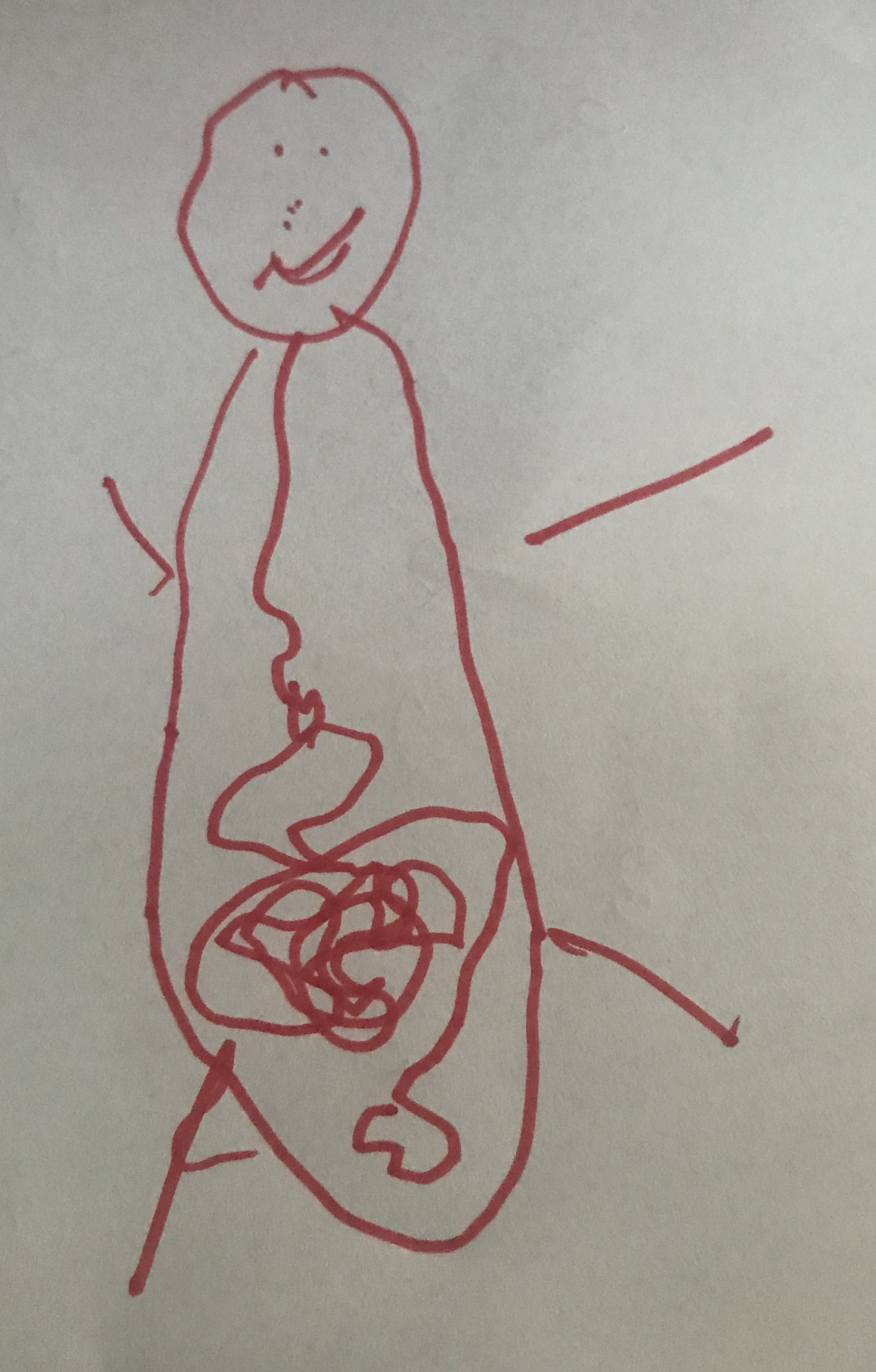
  • Yog explaining importance of digestive system :

    First I will drink milk. It will go in my stomach and then in my intestines. From there the energy will go in the blood. Then the blood will get the energy into my arms. Only when energy comes into my arms, can I start doing my homework.

    Mama, you have to learn to wait for energy to travel in the body.

    P.S. _ Yogs drawing of the Digestive System

    #homeschoolinglife

    #digestiveSystem

  • Soon, there will be a day when all Children will learn the same way

    When Nature kills all oranges, lemons and strawberries to only produce apples

    When artistes have hanged themselves and writers have been exiled

    When only bankers are needed to protect our money and doctors, engineers or teachers will die

    Oh! Don’t despair! There is still tons on hope for this day to come

    When all children will learn the same way

    When everyone will follow rules by the book

    When no one will question the power of a few

    When man kind doesn’t dream anymore

    When all children will learn the same way

    Till such time, keep you head low, your eyes downcast

    Set aside your brain and never raise a question

    Leave behind your memories and your wishes

    Just breathe till one day you no longer feel the need to do so

    For that day is soon going to come when all children will learn the same way

  • I am changing the world, making it a better place

    I save lives each day, give hope where there’s none

    I am a doctor

    I haven’t spoken to my father in the last 5 years

    I am changing the world, making it a better place

    I guide CEOs on their investment decisions

    I am a Banker

    I don’t know which grade my daughter is in or who she is dating

    I am changing the world, making it a better place

    I nurture young minds on how to develop their free thought

    I am a teacher

    I don’t have time to heed to the idiosyncrasies of my Mother in law

    I am changing the world, making it a better place

    I work with the under privileged, being there for those who don’t have anyone else

    I am a social worker

    My mother killed her self out of depression

    I am changing the world, making it a better place

    I guide my team to become better versions of themselves

    I am a leader

    My child is a drug addict

    I am changing the world, making it a better place

    I really hope someone,out there, is working on helping my world too

  • I was thinking I was normal

    as normal as I could be

    Living in my own world

    Can’t decide who I am supposed to be

    To hate or to love

    To disgust or to like

    To go under or above

    Reaching for my goals, moving towards the sky

    To dance or to fight

    I was born thinking I was normal

    As normal as I could be

    Where people would be telling what is important for me

    Whether to study or to play

    To fail or to pass

    To go or to stay

    And to stay in which class

    But I was wrong

    I am not normal

    I am lucky as lucky as I can be

    Where people do not rule me

    To study or to play

    To fail or to pass

    Or what to say

    I am not ruled but I am taught

    Thanks to these lovely parents that I got


    Toyna wrote this poem in short 10-15 minutes. I loved it so much that I wanted her to put it on her blog. She didn’t and the paper kept floating around from one table to another. I didn’t want to lose it, so I decided to earn brownie points from my readers and put it on my blog.

    Needless to say, my life is full or gratitude for the love and joy we experience every day.